Central coenzyme — the route of administration changes everything
Not approvedLongevity and mitochondria
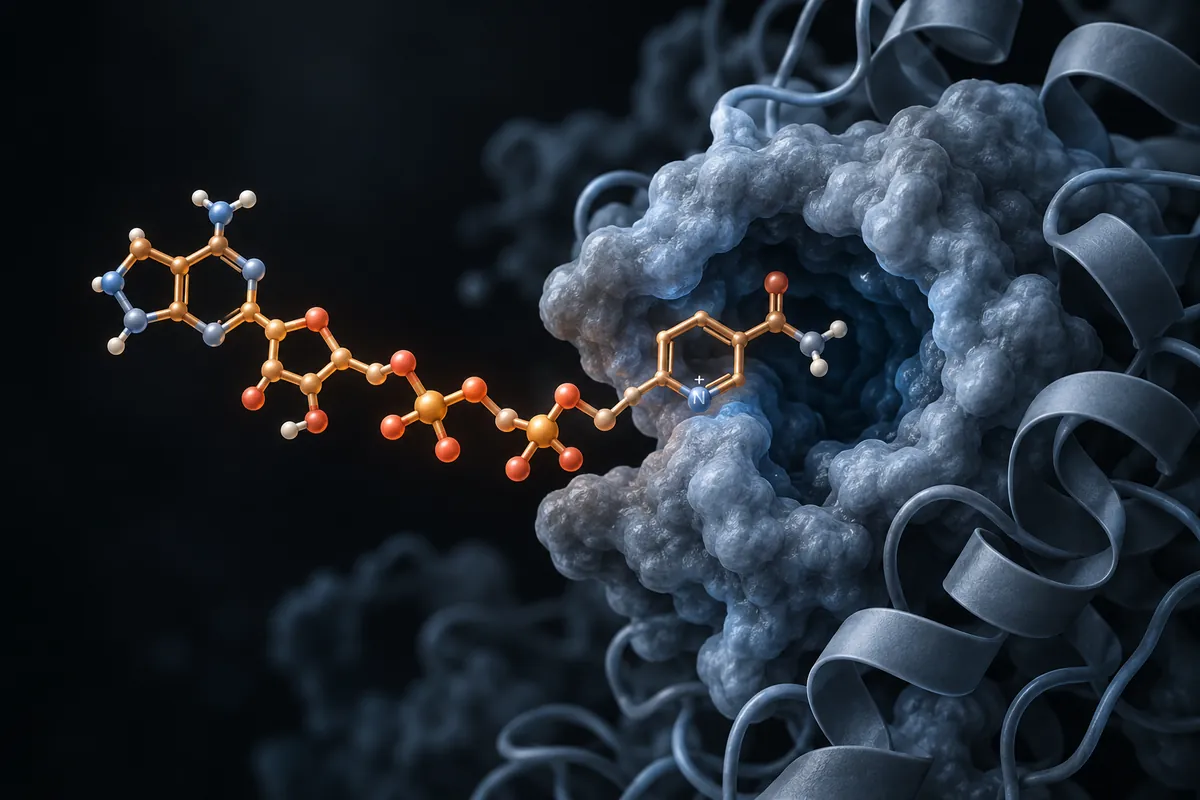
AI-generated illustration. Not data, and not an image from a study.
!
Experimental material. Read before using anything from here.
Nothing on this page is a medical recommendation, prescription or treatment plan. It is an organized translation of protocols circulating in research communities and, where it exists, of what published trials tested. The two are marked differently — and they are not equivalent.
Most of the compounds here have no FDA approval for human use. Several are sold labeled "research use only", which means they have not gone through purity, sterility or dosage controls for human consumption. A community-reported dose is not a validated dose: it is what someone reported having done.
Talk to a licensed health professional before considering any of these compounds. If you already use one and feel anything unexpected, seek care — do not wait for the next routine test.
Summary
Nicotinamide adenine dinucleotide: a coenzyme present in every living cell. The body uses it to convert food into cellular energy (ATP), for DNA repair and to fuel the sirtuins. It exists as subcutaneous, intravenous, intramuscular, oral and pen — and bioavailability across these routes is very different.
Quick reference
Is it a peptide?
No. NAD+ is a coenzyme. It is here because it shares the injectable research format.
Routes
SC, IV, IM, oral (NMN/NR), intranasal/sublingual and pre-mixed pen.
Schedule
SC is usually 2–3×/week. IV is weekly to monthly. Oral precursors are daily.
Status
Injectable NAD+ is not approved as a therapeutic.
NAD+ Injection Dosage and Frequency
NAD+ Injection Dosage and Frequency
Route
Amount per session
Common frequency
Evidence or planning note
SubQ
50-100 mg
2-3 times weekly
Clinic and community planning; direct SubQ evidence is limited.
Intramuscular
50-100 mg
1-3 times weekly
Clinic and community planning; direct route-comparison data are limited.
Intravenous
250-500 mg; 500-1,000 mg in higher-dose clinic protocols
Weekly or every other week; loading schedules vary
Published pilot research and supervised clinic practice.
Pen or premixed format
Label-dependent
Label-dependent
Concentration math only; confirm the listed concentration before calculating.
NAD+ Protocol Formats
NAD+ Protocol Formats
Phase
Dose
Frequency
Notes
Assessment
50 mg
1x weekly or 3x weekly
Inject slowly over 5-10 seconds; assess tolerance.
Titration
75 mg
1-3x weekly
Increase by ~25 mg if assessment phase is well tolerated.
Multiple human RCTs raised blood NAD+ with favorable tolerability.
Nicotinamide Mononucleotide (NMN)
300-900 mg
Daily
60-day dose-response RCT showed dose-dependent NAD+ rise; 600 mg gave the largest effect.
NAD+ Protocol Formats
NAD+ Protocol Formats
Format
Concentration
Dose example
Volume per dose
Pre-mixed vial
100 mg/mL
50 mg
0.50 mL (50 units)
Pre-mixed vial
100 mg/mL
100 mg
1.00 mL (100 units)
Pre-mixed vial (high-conc.)
200 mg/mL
100 mg
0.50 mL (50 units)
Pen device
Set per device
Click-set per dose
Per device label
NAD+ Subcutaneous Injection Dosage Chart
NAD+ Subcutaneous Injection Dosage Chart
Planning phase
Amount per injection
Frequency
Weekly total
Draw-volume note
Evidence type
Assessment
50 mg
1× or 3×/week
50 or 150 mg
Calculate from the final vial concentration
Community and clinic planning
Titration
75 mg
1-3 times weekly
75-225 mg
Calculate from the final vial concentration
Community and clinic planning
Standard maintenance
100 mg
2-3 times weekly
200-300 mg
Calculate from the final vial concentration
Community and clinic planning
Loading (intensive)
100-200 mg
Daily for 7-10 days
700-1,400 mg during a 7-day week
Calculate from the final vial concentration
Supervised clinic practice; not a proven SubQ schedule
NAD+ Reconstitution Chart by Vial Size
NAD+ Reconstitution Chart by Vial Size
Vial amount
BAC water added
Concentration
25 mg
50 mg
75 mg
100 mg
500 mg
5 mL
100 mg/mL
0.25 mL / 25 units
0.50 mL / 50 units
0.75 mL / 75 units
1.00 mL / 100 units
1,000 mg
10 mL
100 mg/mL
0.25 mL / 25 units
0.50 mL / 50 units
0.75 mL / 75 units
1.00 mL / 100 units
100 mg
1 mL
100 mg/mL
0.25 mL / 25 units
0.50 mL / 50 units
0.75 mL / 75 units
1.00 mL / 100 units
750 mg
7.5 mL
100 mg/mL
0.25 mL / 25 units
0.50 mL / 50 units
0.75 mL / 75 units
1.00 mL / 100 units
1,500 mg
10 mL
150 mg/mL
0.167 mL / 16.7 units
0.333 mL / 33.3 units
0.50 mL / 50 units
0.667 mL / 66.7 units
NAD+ Cycle Length: 4, 8 and 12-Week Research Planning
NAD+ Cycle Length: 4, 8 and 12-Week Research Planning
Planning framework
Loading or maintenance context
Review or adjustment point
Evidence type
4-week SubQ planning
Assessment or titration phase
Review at week 4
Community and clinic planning
8-week SubQ planning
Titration followed by a regular planning phase
Review at weeks 4 and 8
Community and clinic planning
12-week SubQ planning
Titration followed by maintenance planning
Review every 4 weeks
Community and clinic planning
IV loading plus maintenance
3-5 daily sessions, then weekly or monthly
Review after loading and every 4-8 weeks
Supervised clinic practice
Continuous or ongoing planning
Frequency may be adjusted instead of using a fixed break
Review every 4-8 weeks
Clinic and community planning
NAD+ vs NMN vs NR (and IV vs SubQ)
NAD+ vs NMN vs NR (and IV vs SubQ)
Feature
NAD+ Injection (SubQ)
NAD+ Infusion (IV)
Oral NMN
Oral NR (Niagen)
Mechanism
Direct coenzyme delivery
Direct coenzyme delivery
NAD+ precursor (converted in vivo)
NAD+ precursor (converted in vivo)
Typical research-planning dose
50-100 mg, 2-3x/week
250-1,000 mg per session
300-600 mg/day
300-1,000 mg/day
Speed to systemic NAD+ rise
Hours
Minutes to hours
Days to weeks
Days to weeks
Strongest human evidence
Limited
Pilot PK and historical case reports
Growing RCT base
Strongest RCT base
Convenience
At-home injection technique required
Clinic visit, 2-4 hour infusion
Daily oral capsule
Daily oral capsule
Regulatory status
Not FDA-approved; compounded only
Not FDA-approved; compounded only
Not currently a dietary supplement in the US
GRAS/NDI dietary supplement
Cost (research-context)
Moderate per cycle
High per session
Moderate monthly
Moderate monthly
NAD+ Cycle Lengths Used in Human Research
NAD+ Cycle Lengths Used in Human Research
Study
Route
Schedule
What it tells us
Grant et al., 2019 pilot
IV infusion
One 6-hour infusion; 750 mg total
Acute NAD+ metabolism during one infusion. It did not test a multi-week cycle.
Yu et al., 2026 randomized trial
IV infusion
10 mg 1×/day for 7 consecutive days
A 7-day disease-specific research course in adults with ischemic cardiomyopathy. It does not establish a general wellness cycle.
Reyna et al., 2026 retrospective pilot
IV infusion
500 mg daily for 4 consecutive days
A commercial four-day loading pattern with 30-day follow-up. The authors said longer-term dosage and effectiveness still need study.
Nkrumah-Elie et al., 2026 preprint, Trial 1
SC, IM, or IV bolus
Three consecutive administration days, then a 7-day washout
Short-term injection tolerability across routes. This was an acute pilot, not proof of a repeating cycle.
What About 4-, 8-, and 12-Week NAD+ Cycles?
What About 4-, 8-, and 12-Week NAD+ Cycles?
Cycle length
Evidence status
How to interpret it
4 weeks
Not an established injectable standard
Longer than the direct NAD+ administration periods in the human studies summarized above. Treat four-week schedules as clinic or community practice unless a specific study is cited.
8 weeks
Not an established injectable standard
A common online cycle length, but direct human NAD+ injection trials do not validate eight weeks as the preferred duration.
12 weeks
Not an established injectable standard
Sometimes used as an extended cycle in community material. Direct long-term injectable NAD+ evidence is not strong enough to call twelve weeks a standard.
Continuous use
Not established for injectable NAD+
Current direct injection studies are too short to define an evidence-based indefinite schedule.
Human Research Schedules
Human Research Schedules
Research context
Evidence note
Single 6-hour infusion
3-day injection pilot
4-day IV loading period
7-day IV research course
IV, Subcutaneous, and IM NAD+ Cycles Are Not Interchangeable
IV, Subcutaneous, and IM NAD+ Cycles Are Not Interchangeable
Route
Human evidence example
Cycle interpretation
Slow IV infusion
750 mg over 6 hours in the 2019 metabolic pilot
Useful for acute infusion metabolism; not a subcutaneous cycle template.
IV infusion
500 mg on four consecutive days in the 2026 retrospective study
Documents a commercial loading pattern, not a universal cycle.
IV infusion
10 mg daily for 7 days in a heart-failure trial
Disease-specific clinical research; not a general cycle standard.
SC / IM / IV bolus
Three consecutive days in the 2026 injection pilot
Short-term route comparison and tolerability research.
Published Research vs Community NAD+ Cycles
Published Research vs Community NAD+ Cycles
Source type
What it can show
What it cannot prove
Randomized human trial
What happened under a defined schedule in a specific study population
That the same schedule is best for other populations, routes, or goals
Pilot human study
Early pharmacokinetic, route, or tolerability data
A mature long-term cycle standard
Retrospective clinic data
How a real commercial protocol was used and what was observed
That the protocol is superior or clinically established
Clinic protocol
How one practice structures care
That the schedule has been validated in controlled research
Community-reported cycle
What people say they commonly run
Safety, effectiveness, or an evidence-based cycle length
Storage and handling
The rules below apply to practically every lyophilized peptide in this reference. Where a compound has its own requirement, it appears in the table in the previous section.
Lyophilized powder, sealed: refrigerator, between 2 and 8 °C, protected from light. Many tolerate room temperature for short transport periods, but that is tolerance, not a recommendation.
After reconstitution: always refrigerated, between 2 and 8 °C. The stability window drops to days or a few weeks, depending on the compound.
Never freeze after reconstituting. The freeze–thaw cycle degrades the peptide.
Do not shake. Swirl the vial slowly. Shaking breaks the peptide chain.
Bacteriostatic water down the wall of the vial, in a slow stream, not squirted directly onto the powder.
Cloudy solution, with particles or a color change: discard. There is no recovery.
Lab tests and monitoring
This list is the one that appears recurrently in the source, with small variations by compound. It serves as a starting point for a conversation with a professional — not as a substitute for that conversation.
Before starting: complete blood count, comprehensive metabolic panel, lipid panel, fasting glucose and HbA1c, TSH and free T4, blood pressure and resting heart rate.
Depending on the compound: IGF-1 (GH axis), lipase and amylase (VIP and the incretin agonists), serum copper and ceruloplasmin (GHK-Cu and blends containing it), CRP.
Reassessment: most protocols review between week 4 and week 8, and then every 8–12 weeks.
Do not wait for the routine lab test in the face of abdominal pain, visual changes, a change in a mole, shortness of breath, asymmetric swelling or any new and persistent symptom. That is a reason to seek care, not a spreadsheet item.
Evidence limits
What these numbers are and what they are not. The values above were preserved exactly as they appear in the source, without reinterpretation. What the source describes as community practice is marked as such in the tables; what came from a published trial is too. A dose repeated by many people does not become a validated dose by repetition.